Stand in Crestline Park on a summer evening and the loudest thing you are likely to hear is a lawnmower. A hundred years ago it would have been a cowbell. The streets we live on were pasture then, grazed by dairy herds that knew their own way home, and the milk from those herds went out across the city every morning.
No one wrote down the day the first plow broke ground in Shades Valley, and the honest answer is that we do not know it. This was Creek land until the cessions of the early 1800s opened it to settlement. Jefferson County was organized in 1819, and Elyton, the county seat Birmingham later absorbed, was laid out in 1821. Somewhere in the decades after that, families began clearing the ridges and hollows on this side of Red Mountain and putting in crops. The farming came before the mines, before the railroad, and before the neighborhood. It did not come before the 1820s.
The soil in Shades Valley was thin, never rich enough for cotton or a big row-crop farm, though plenty of families worked it as "truck" farmers raising vegetables to sell in town. What the valley grew well was grass. Marilyn Davis Barefield, whose History of Mountain Brook is one of the two records we have of this era, put it plainly: the land produced good forage for cattle. So after Birmingham was founded in 1871 and a whole city needed milk every morning, the families out here turned from the plow to the herd. Shades Valley became dairy country.
A good deal of that dairy country is now your front yard. Jim Baker ran a dairy off the east end of Sims Avenue in the late 1920s and early 1930s, and Barefield records that his pasture land is now Crestline Park. Jim was one of the Baker brothers of Baker's Dairy, the biggest name in the valley's milk business. His nephew wrote later that Uncle Jim "pulled out of the Baker family business" and set up for himself about two miles from the big Baker barn. Those two miles put his cows on the ground that became our park. The grass they ate is under our streets.
That nephew, Joe William Baker, grew up here in the 1930s and remembered exactly where the corn met the road. Of the lane that left Montevallo Road next to Mrs. Grefseng's pasture, he wrote: "It is now called Dunston Avenue. It ran for a good way before it came to a community of homes. On each side of the road there were corn fields. On one side was the fields that fed the Baker Dairy cows and across the road was the fields of the Watkins Dairy." Dunston Avenue was corn then, feeding cows on both sides of the lane. The community of homes it ran to was the little Hoadley subdivision, on the county's books since 1907, back when its streets still carried names like Central and Franklin. The Watkins operation across the road was Jefferson Dudley Watkins's dairy, on the hill between Montclair Road and Euclid Avenue where St. Francis Xavier sits today. White Dairy bought Watkins out around 1940, but the Watkins house, built in the mid-1920s, still stands on Beech Street.
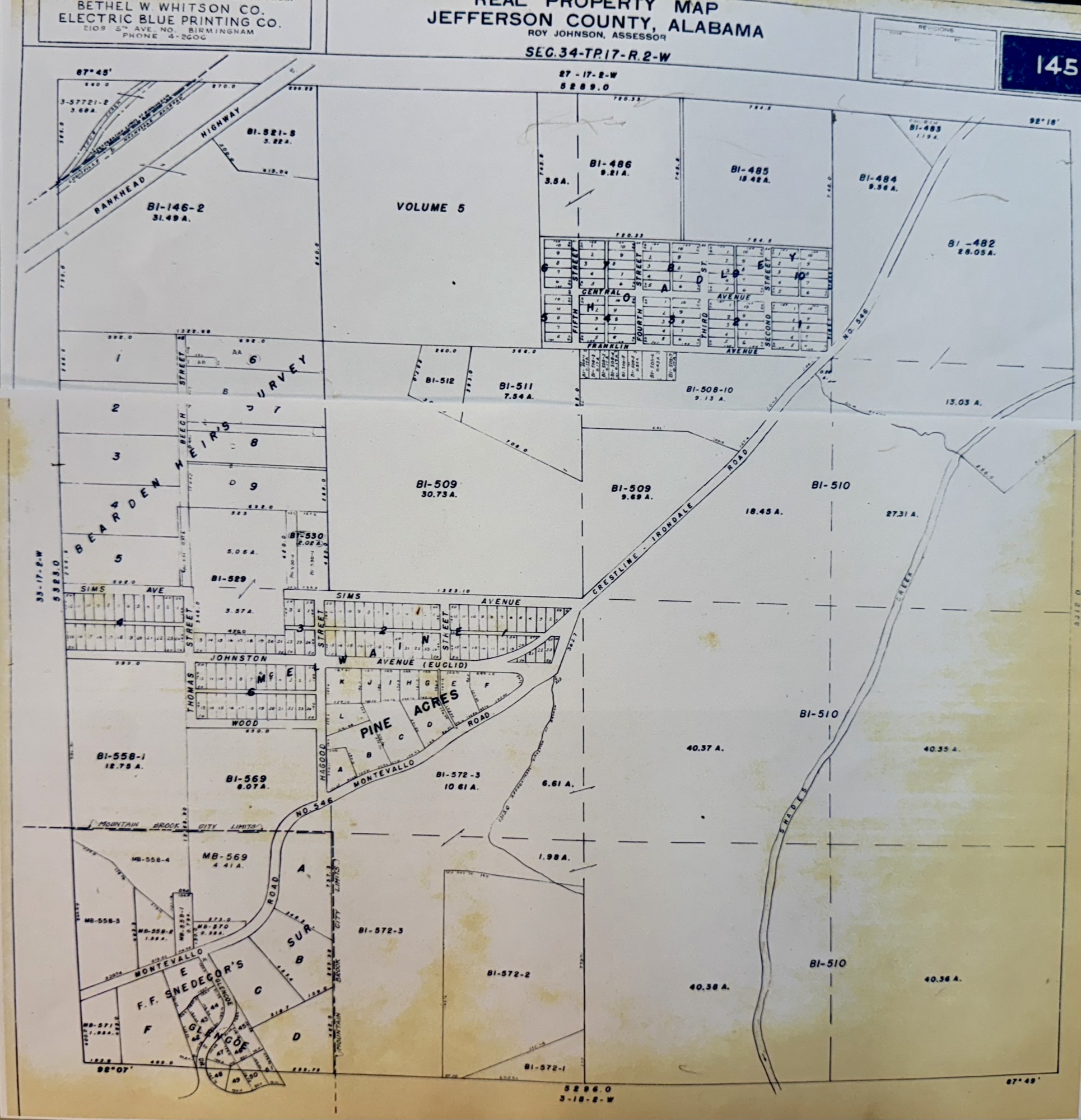
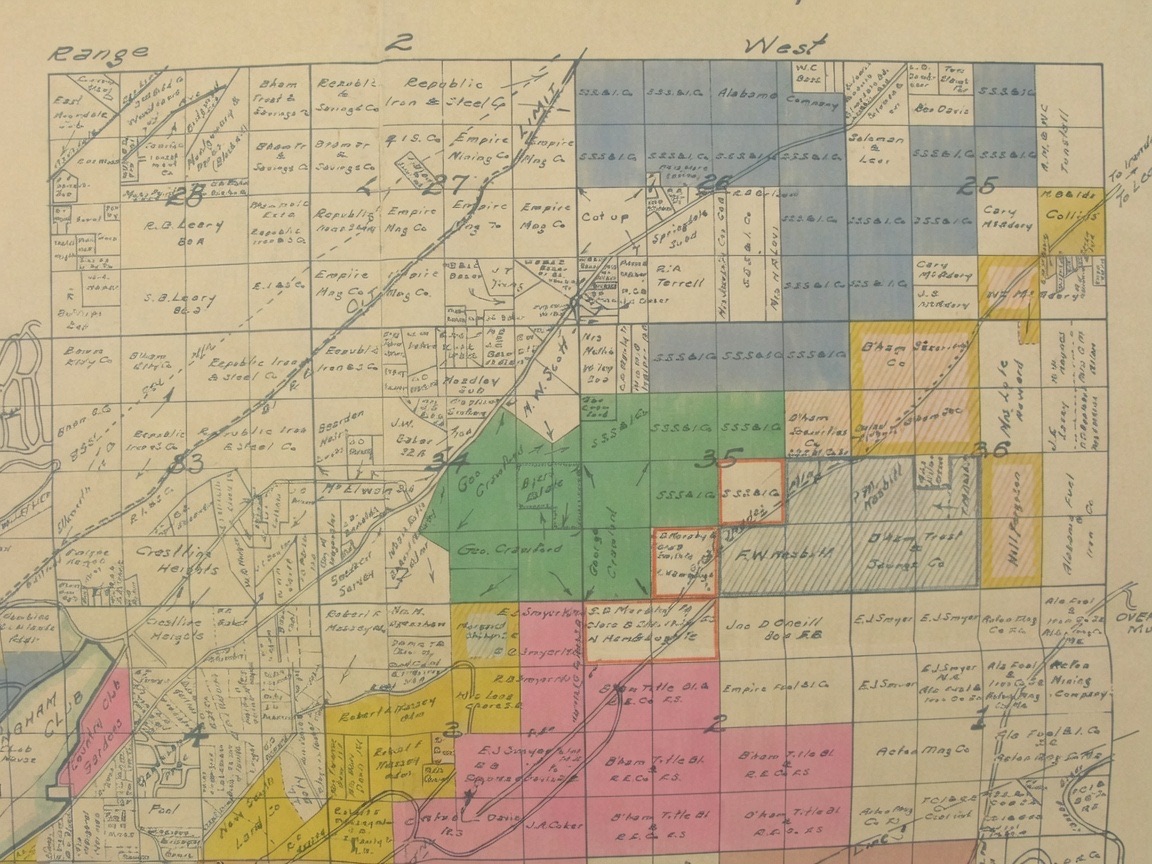
The biggest herd close by belonged to White Dairy. Peyton Powell Baker ran it first out of the basement of his 1912 home at the corner of Montevallo Road and Church Street, then moved the office half a block into Crestline. His herd ran as high as 280 head, grazing across these pastures and down along Shades Creek on the bottomland that later became the golf course at the Mountain Brook Club. The cattle walked out to grass at dawn and back at dusk on the same route every day, and M. M. Argo, Jr. remembered the whole herd plodding past his house on Montrose Road, morning and evening. The County Health Department came by the White Dairy office every day to check the bacteria count, because the milk went out as certified raw milk, which many people then preferred to the pasteurized milk that came later. Barber Dairy bought White Dairy around 1935 and kept running it under the old name.
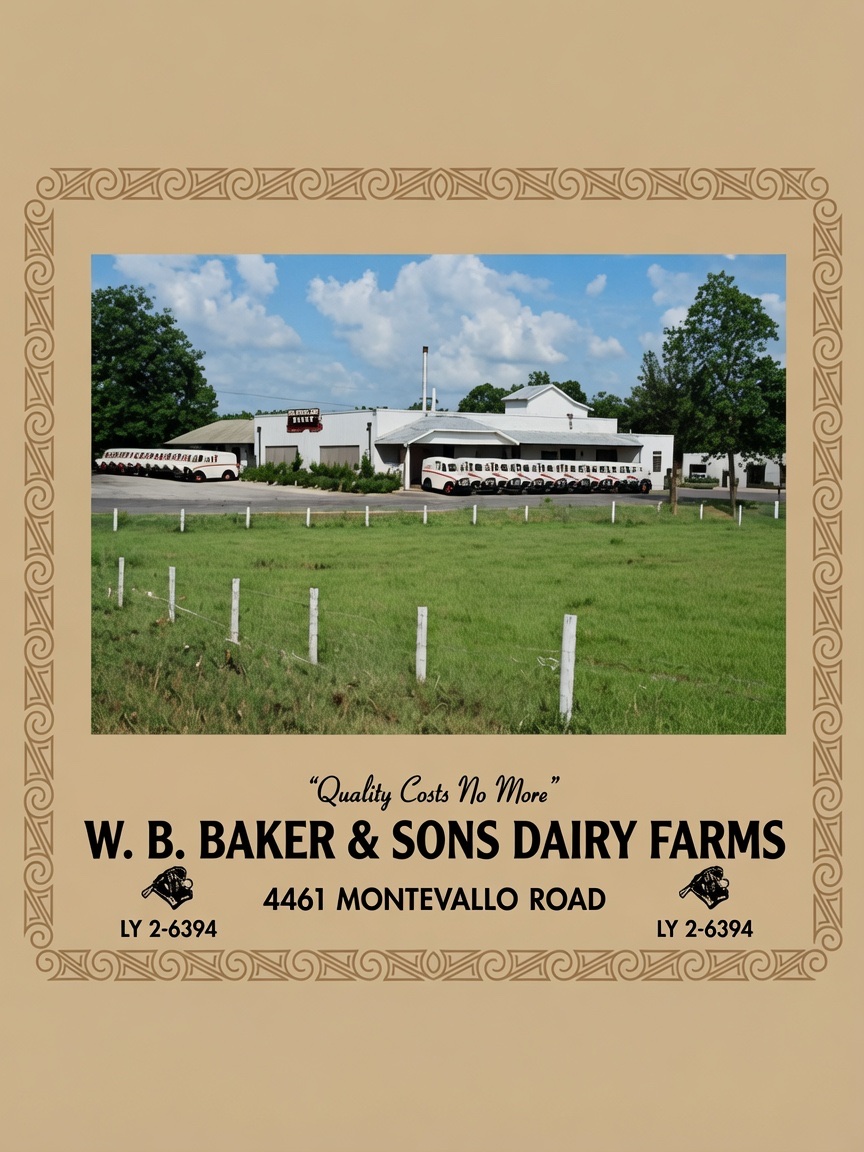
The Baker name was all over this valley for a reason. In 1906 two brothers, W. B. and P. P. Baker, ran the Baker Brothers Feed and Grain Store on Morris Avenue downtown. They decided the Birmingham air was no good for their growing families, bought land out in the country of Shades Valley, and went into milk, opening the two dairies that anchored the district: W. B. Baker & Sons and White Dairy. The "& Sons" part was earned. William Bradford Baker's boys carried the business their whole lives: George kept the books, bought feed by the railroad carload, and ran the farming; Ed ran the herd from three-thirty every morning; Powell strung the fences and bought the family's supplies; Frank ran a second Baker dairy farm down in Shelby County; and Jim struck out on his own and grazed the park. The home place sat at 4461 Montevallo Road in the heart of McElwain, its pasture and company houses running for blocks, directly across from the McElwain School. The oval sign out front read "Since 1906," the year the brothers first went into milk. Around 1925 the family raised the big barn there, the largest dairy barn in Alabama at the time, with 156 stalls, machine milking, and a steam dynamo generating its own electricity. When the well diggers hit an underground stream, the artesian well that came in watered the company houses, the Baker homes, the school, and the church.
The showpiece came a few years later, a few blocks away on Montclair Road. The Bakers built a milking parlor there where the cows were milked on a raised floor behind plate glass, the milk running through sealed lines into a five-gallon glass jar on a scale, so a visitor could watch the whole trip from cow to bottle and see exactly what each cow gave. Families drove out on Sunday afternoons to watch, and the dairy kept a greeter in dairy whites on hand to meet them. Schools brought field trips. Because no human hand and no open air ever touched the milk, the Health Department let the Bakers sell it as certified milk, the only certified milk in Birmingham, and doctors recommended it for babies. Barefield tells the same story from the road: carloads of people parked along the highway just to sit and watch a machine milk a cow.
There were others closer in. Happy Dale Dairy, run by J. L. Wilkinson with Charlie Jones helping, sat in the Crestline area on land owned by George Gordon Crawford, president of the Tennessee Coal and Iron Company. For a while it went by the name Golden Guernsey Dairy. Kirk's Dairy stood right in the McElwain community, and Baker's memoir places it exactly: R. W. Kirk's dairy sat on the other side of Montevallo Road, and when Kirk closed the dairy he went back to working a good-sized truck farm, the old fallback of the thin-soil valley. Draw those operations on a map and they box in the ground we live on.
All of it ran on corn. The fields on the school side of Montevallo Road grew silage corn from the Walker house to the school, and another field ran from the church almost to Dunston Avenue, which was then just a lane. The rule of the place was that corn went in the ground by the Fourth of July, no later, or it would never make silage by cutting time. One Fourth, when a field had to be replanted, the rest of the Bakers walked down Montevallo Road to a holiday picnic on Shades Creek while Joe and his brother Ned spent the day behind a mule-drawn planter putting the whole field back in. Cutting came in September: crews with corn knives took the stalks off six inches above the ground, and a belt-driven cutter chopped them into inch squares and blew them up an eight-inch pipe into the silos. They grew pole beans right in the corn, the stalks serving for poles, and picked ten to fifteen tons of beans a year for the grocery stores at a cent a pound. A boy who could pick a hundred pounds in a day earned a dollar, and in a time of no money that was real money.
The dairy carried the neighborhood along with it. Company houses lined Montevallo Road, and the men in them ran the milking machines, sterilized the pails and pipelines with raw steam, and drove the nine delivery routes. The milk trucks doubled as the community's buses: children rode to Irondale School sitting on upturned milk cases, and when the church young people had their study course in Irondale, a Baker's milk truck hauled the whole crowd the same way. At 3:30 in the morning the produce truck left for Hill's and the A&P loaded with corn and beans. As teenagers, Joe and Ned ran a produce route of their own through Crestline and Mountain Brook three afternoons a week, and on the side they raked, sacked, and sold dried cow manure to the ladies of Mountain Brook for their rose beds, fifty cents or a dollar a bag, the chauffeurs helping load the trunks.
Joe William Baker set all of this down in 1993 in a memoir called A Time When, written from a boyhood spent inside the operation. He was William Bradford Baker's grandson, born in 1922, and as a boy he was up at 4:30 feeding calves before school for fifty cents a week plus lunch money, driving tractors at twelve, and filling in on milk routes as a teenager. His McElwain was "somewhat of an agriculture place half-way between Mountain Brook and Irondale," a three-room school, a church, gardens, and the dairy in the middle of it all. Nearly every family around it kept a hog pen for winter meat and a cow staked out wherever grass grew, and the children brought the cow in for milking after school. His memoir and Barefield's history are the two windows we have onto this ground before the neighborhood came, and the Baker family story is rich enough to deserve a page of its own in this series.
What ended the dairy era was the same thing that made Crestline: houses. When the Jemison company started laying out its subdivisions, the loose old arrangement came apart. Cattle that had wandered the roads and yards freely now had to be fenced off the streets, the gardens, and the new golf course, or moved out for good. The Beardens pulled up and went out to Rocky Ridge Road, where their stone dairy barn still stands beside the shopping center. Bearden's herd and Winthrop Hix's herd had grazed together and roamed the neighborhood all day, and Barefield wrote that when evening came, "both herds knew the proper paths to take," each going home to its own barn. The Bakers went the other direction: after the war the family took the operation from a farm to a corporation, and it outlived every other name in the valley. A notice bound into the back of Joe's memoir, from Baker & Sons Dairy, Inc., announces the end of the returnable glass bottle, and it opens with the words the family had spent a lifetime earning: "We have been packaging milk and milk products in glass bottles since 1906."
The plow gave way to the herd, and the herd gave way to the house. The pasture is under the pavement now. If you have ever wondered why some of the streets in this corner of Crestline wander the way they do, part of the answer is that a few of them began as the paths a milk cow walked to grass and back, twice a day, until the grass became a lawn. Dunston Avenue runs straight now, squared up when Crestline Park was platted in 1948, but you can still drive Joe Baker's horseshoe. Leave Montevallo Road on Dunston, where the corn stood on both sides of the lane, and take it all the way up to Hagood Street. Turn right, and Jowers Lane passes on your left, the hill where the Jowers families lived. Turn right again on Gladstone Avenue and ride it back down to Montevallo Road. That is the loop Johnny Cornwell rode on horseback throwing the Birmingham News, the last leg of his paper route. The corn is a lifetime gone, and the herds went with it. The Baker name stayed: one street over from Dunston, it is still on the map as Baker Drive.
Sources: Marilyn Davis Barefield, A History of Mountain Brook, Alabama, and Incidentally of Shades Valley, Chapter V, "Mountain Brook Dairies," which rests on interviews with the Postelle, Watkins, Bearden, and Argo families, the 1910 Alabama census (Southern History Department, Linn-Henley Research Library), and Samford University's "History of Cahaba Heights." Joe William Baker, A Time When (1993), the memoir of William Bradford Baker's grandson.
Crestline Neighborhood Association · Local History Series